
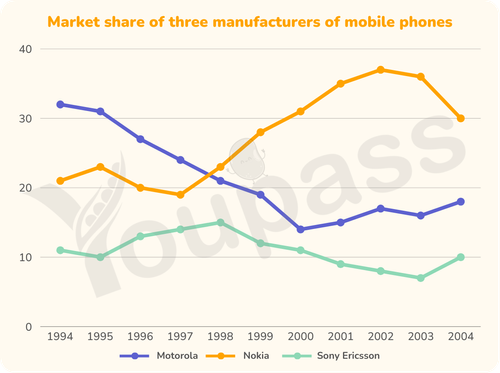
The line chart compares how the percentage of mobile phone sales by three producers (Motorola, Nokia and Sony Ericsson) varied from 1994 to 2004. Overall, the percentgae for Nokia became increasingly significant, while that of Motorola dropped gradually. Moreover, the figure for Sony Ericsson experienced a relative stability over the period, despite some fluctuation. Regarding the statistics for Nokia initially stood at over 21%, whereas that of Motorola started at its peak, accounting for 33%. In 1996, having declined sharply to 20%, the data for Nokia then hit its bottom at only 19%. In 2000, a dramatic decrease was witnessed in the percentage of Motorola, hitting its lostest figure at only 13%. In contrast, The proportion of Nokia reached the peak at over 37%. In the remainder of timeframe showed opposite tendency. Concerning Son Ericsson's data. In 1998 after recording a upward trend, this producer's figure then peaked at 15%. In the next 5 years, its data plunged, meeting its lowest proportion at 7%. In the next year, there are a sharp upward trend, ending at 10%
Sample Detail
The line graph below illustrates the proportion of mobile phone sales by three manufacturers (Motorola, Nokia and Sony Ericsson) between 1994 and 2004. Summarise the information by selecting and reporting the main features, and make comparisons where relevant.
20/07/2026 05:06 6.5 points
Topic
The line graph below illustrates the proportion of mobile phone sales by three manufacturers (Motorola, Nokia and Sony Ericsson) between 1994 and 2004. Summarise the information by selecting and reporting the main features, and make comparisons where relevant.
Word count: 177
Chart/Graph
Essay
Overall Scores
6.5±0.5
Fair
Writing Criteria Scores
TA7.0
CC7.0
LR6.0
GRA7.0
Click on any highlighted text in the essay to view detailed suggestions for improvement.
Deep Analysis
Task 1 - Academic Writing
4 tools available
Sample Essay - IELTS Writing Task 1
No sample essay
Click the button below to analyze and generate a high-quality sample essay for Task 1.