
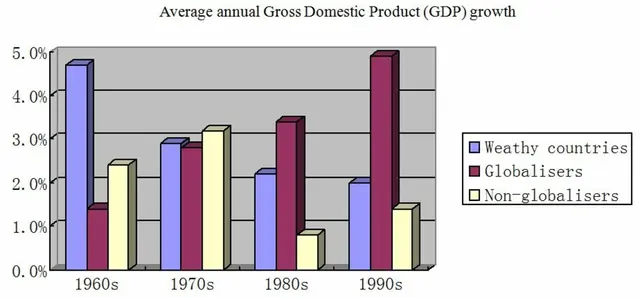
The bar chart illustrates changes in the average internal products in developed countries, globalisers and non-globalisers throughout the 3-decade span from 1960s to 1990s. Overall, globalisers consistently generated the highest percentage at the end of the period with a skyrocketing trajectory, while the opposite was true for well-to-do countries, which observed a plummet and lose the leading position in the first duration. Non-globalisers remained lower and volatile during this period. Notably, each category had taken the lead at a specific decade. As shown, the average growth in local merchandise in rich countries was considerably higher than the counterparts, with nearly 5% in 1960s. From that point onward, the proportion of developed countries experienced a steady downward trend, from 2,9% in 1970s to 2.1% in 1980s and bottoming at 2% in 1990s. By contrast, globalisers consistently recording the lowest GDP in 1960s, then its average growth in GDP subsequently climbed to 4.9% in 1990s, becoming the highest proportion over 30 years. The remaining category was experienced in a smaller percentage. As can be seen, non-globalisers underwent notable variations over the course of the decades. The figure for people who do not globaliser rose marginally from 2.3% to 3.1% in the 1970s, when it overtook others to take the top. After that, it declined significantly to 0.8% in 1980s and recovered at 1.3% in 1990s
รายละเอียดตัวอย่าง
The graph below shows the average growth in domestic products in wealthy countries, countries that have adopted a global approach to business and countries that have not.
20/07/2026 09:19 7.0 คะแนน
หัวข้อ
The graph below shows the average growth in domestic products in wealthy countries, countries that have adopted a global approach to business and countries that have not.
จำนวนคำ: 223
แผนภูมิ/กราฟ
Essay
คะแนนรวม
7.0±0.5
ดีมาก
คะแนนเกณฑ์การเขียน
TA7.0
CC7.0
LR7.0
GRA7.0
คลิกข้อความที่ไฮไลต์ในเรียงความเพื่อดูคำแนะนำรายละเอียดเพื่อพัฒนา
การวิเคราะห์เชิงลึก
Task 1 - Academic Writing
4 tools available
บทความตัวอย่าง - IELTS Writing Task 1
ยังไม่มีบทความตัวอย่าง
กดปุ่มด้านล่างเพื่อวิเคราะห์และสร้างบทความตัวอย่างคุณภาพสูงสำหรับ Task 1