
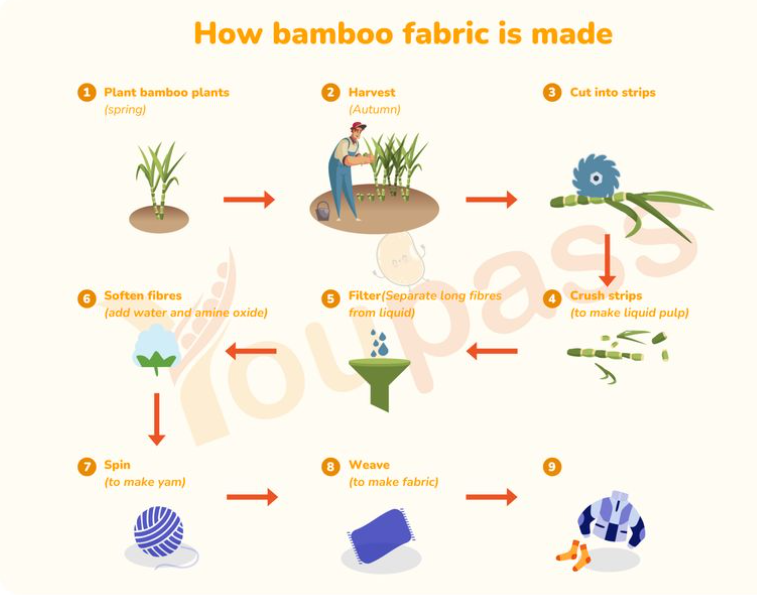
The diagram illustrates the manufacturing process of converting bamboo into fabric through various steps. Overall, there are 9 distinct stages involved in the production of bamboo fabric, starting with the cultivation of bamboo in spring and culminating in the creation of woven products Additionally, the process combines both industrial and agricultural techniques, requiring months to complete from initial plantation to the final product. The manufacturing procedure commences with bamboo planting during the spring season. After a certain period of growth, fully grown bamboo will be harvested in autumn, when the plants have achieved their optimal size for cultivation. Collected bamboo will then be shredded into thin strips by specialized cutting machinery, before being crushed to produce liquid pulp. The pulp undergoes a filtering process to isolate long fibres from the liquid. The following stages focus on refining and processing the extracted fibres. Water and amine oxide will be added to soften the fibres, rendering they are suitable for textile production. Afterwards, the fibres are subsequently spun to make yarn, which serves as a primary raw material for weaving the final product. In the final stages, the yarn is woven into the finished bamboo textile, bringing the manufacturing process to a close.
Sample Detail
The diagram below shows how fabric is manufactured from bamboo. Summarise the information by selecting and reporting the main features, and make comparisons where relevant
21/07/2026 05:01 7.0 points
Topic
The diagram below shows how fabric is manufactured from bamboo. Summarise the information by selecting and reporting the main features, and make comparisons where relevant
Word count: 201
Chart/Graph
Essay
Overall Scores
7.0±0.5
Good
Writing Criteria Scores
TA7.0
CC7.0
LR7.0
GRA7.0
Click on any highlighted text in the essay to view detailed suggestions for improvement.
Deep Analysis
Task 1 - Academic Writing
4 tools available
Sample Essay - IELTS Writing Task 1
No sample essay
Click the button below to analyze and generate a high-quality sample essay for Task 1.