
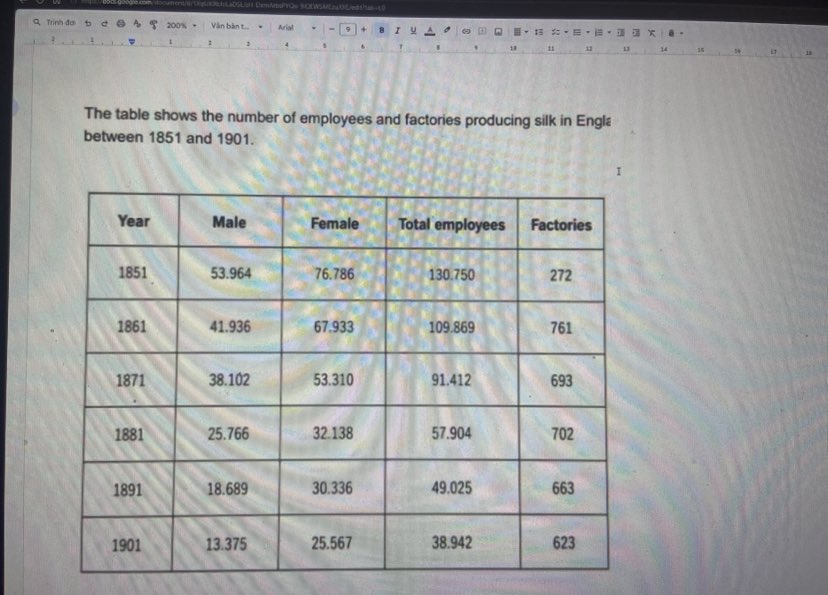
The given table illustrates how many job-holders and manufacturers involved in silk production in England from 1851 to 1901. Regarding the textile workers and total number of employees, it is conspicuous that the surveyed statistics for those underwent a downward trajectory throughout half a century. The highest position of all witnessed at the outset, particularly with the total producers peaking at above 130,000, comprising more than a half female workers (nearly 80,000) and the remainder being their male counterparts (roughly 54,000). By showing no signs of recovery from 1881 onwards, the figures for aggregate workforces constantly experience a dramatic decline until reaching their nadir at just a third of its starting quantity with nearly 40,000, with the number of female weavers nearly doubling that of males. Turning to the number of manufacturing facilities, despite experiencing some slight decrease, it presented a stark contrast by being the only category to go through an upward trend. Commencing with the lowest statistics at 272 in the initial year, the emergence of new-built factories promoted the most significant growth, nearly tripled baseline to claim its zenith in the next decade before leveling off slightly to 702 in 1881. Over the remaining years, the trend reversed with the steadily decrease, hence also closing the period at a number of manufacturing facilities exceeding far that at the outset with 623.
Sample Detail
The table shows the number of employees and factories producing silk in England and wales between 1851 and 1901.
21/07/2026 16:05 6.0 points
Topic
The table shows the number of employees and factories producing silk in England and wales between 1851 and 1901.
Word count: 224
Chart/Graph
Essay
Overall Scores
6.0±0.5
Fair
Writing Criteria Scores
TA6.0
CC6.0
LR7.0
GRA6.0
Click on any highlighted text in the essay to view detailed suggestions for improvement.
Deep Analysis
Task 1 - Academic Writing
4 tools available
Sample Essay - IELTS Writing Task 1
No sample essay
Click the button below to analyze and generate a high-quality sample essay for Task 1.