
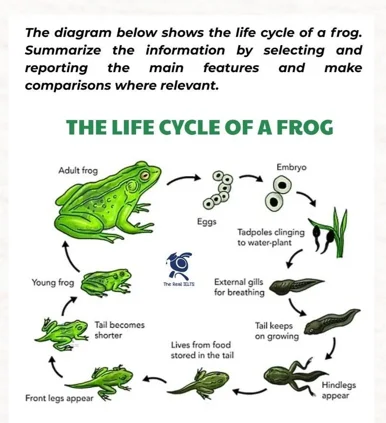
The diagram shows the natural life cycle of a frog. In general, there are six main stages in the development of a frog, starting with the mating between two adult frogs and ending with the appearance of a mature frog. At the first stage, female frogs lay a number of eggs under the water. These eggs then develop into embryos, with a fairly similar look as they are still eggs. Subsequently, the embryos hatch, turn into tadpoles with tails, which are often seen clinging to water plants. Also, at this stage, an important part starts to grow on tadpoles, called external gills, helping them breathe. After that, the tail keeps on growing. At the next stage, these tadpoles grow significantly. Their hindlegs emerge and now they can feed on food stored in the tails. The front legs then appear, entailing the shortening of the tails. The subsequent stage is that the tail completely disappears and the frog turns into a young frog. It grows into an adult and begins its reproduction.
Sample Detail
The diagram below shows the life cycle of a frog. Summarize the information by selecting and reporting the main features, and make comparisons where relevant.
22/07/2026 17:29 7.0 points
Topic
The diagram below shows the life cycle of a frog. Summarize the information by selecting and reporting the main features, and make comparisons where relevant.
Word count: 171
Chart/Graph
Essay
Overall Scores
7.0±0.5
Good
Writing Criteria Scores
TA7.0
CC7.0
LR7.0
GRA7.0
Click on any highlighted text in the essay to view detailed suggestions for improvement.
Deep Analysis
Task 1 - Academic Writing
4 tools available
Sample Essay - IELTS Writing Task 1
No sample essay
Click the button below to analyze and generate a high-quality sample essay for Task 1.